

CAPITAL PROJECTS
ABOUT TUCKER
The City of Tucker, GA was incorporated in 2016 after a landmark vote by the residents in November 2015. Driven by the need to protect the community from another cityhood effort proposing to include part of the residential and commercial areas, the residents of Tucker voted for self-governance with a resounding 73% yes vote.
Like many cities and communities, Tucker has a long and storied history dating back to the 1800’s. First formed as a railroad community, Tucker officially made it on the map when the first post office was founded and a railroad depot established, both in 1892. From the founding families to the myriad of volunteers today, the drive for success has been fueled by our sense of community.
This community driven need to care for each other is what ignited the flame for self-governance. Following a series of municipal incorporations in the state of Georgia, a neighboring area proposed a map for incorporation that included half of the understood community of Tucker. Three years of education, boundary compromise and time at the State Capitol resulted in the opportunity for the community to vote yes to a better way.
Tucker is now eight years old and primed to launch into the future. Through guidance and partnership with experienced companies like Jacobs, Interdev and Lowe Engineering, Tucker created a solid and fiscally responsible foundation for the local government. Years of listening, planning, and keeping the community foremost in all decisions, Tucker has set into place guidance documents, master plans and just recently added services to the charter with the successful referendum for a local Department of Public Works.

TOP PRIORITIES
- CONNECTIVITY
Trails and Transportation - COMMUNITY
Parks and Recreation - GROWTH
Economic and infrastructure
BY THE NUMBERS
- TOTAL POPULATION
37,658 - race
White 41.0% Black 35.8%a Asian 8.3% Other 14.9% - TOTAL BUSINESSES
3,566
TRAILS AND TRANSPORTATION
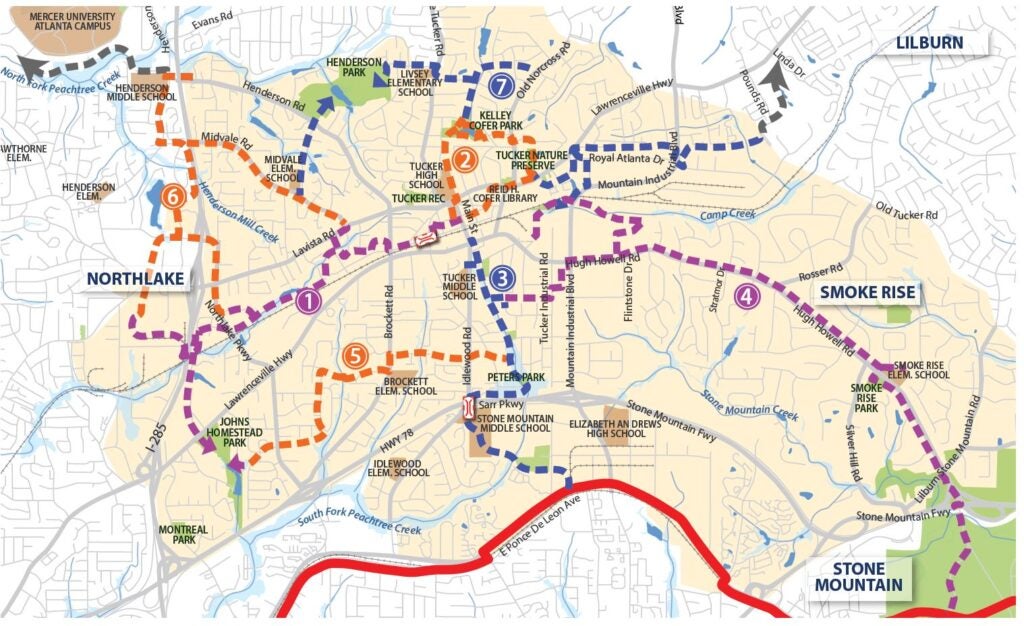
The City of Tucker, at 22 square miles, recognizes the importance of creating safe and convenient transportation options for its residents. Many cities share this need for better multi-modal transportation.
In 2019, the Mayor and Council adopted a comprehensive Trail Master Plan developed by the PATH Foundation and Kaizen Collaborative. This ambitious plan envisions a network of 32 miles of trails, including greenway trails, side paths, and neighborhood greenways. These trails will connect seven schools and seven parks throughout Tucker.
The City has already begun making progress. The Model Mile, a path running alongside Main Street businesses, is a completed example. It ends at a planned greenspace currently under design. Additionally, Phases 1 and 3 are underway, which will extend the Model Mile west to connect with retail and businesses in the Northlake district, and south to connect with Peters Park, Tucker’s historic Black neighborhood.
Phase 1 design and engineering are being 80% funded in part by an ARC Grant through the Transportation Improvement Program (TIP), with matching funds from the City.
Tucker is committed to further enhancing connectivity and pedestrian access to resources and retail corridors by filling in identified sidewalk gaps.
THE CITY OF TUCKER IN DEKALB COUNTY, GEORGIA HAS BEEN AWARDED $850,000 FROM US HOUSING AND URBAN DEVELOPMENT (HUD) FOR PARTIAL RIGHT-OF-WAY ACQUISITION FOR THE TUCKER GREENWAY CONNECTOR.
The proposed project will link the City’s commercial areas, retail establishments, and residential corridors to community parks and regional destinations through a network of sidewalks and multi-use paths, ensuring a secure route for both pedestrians and cyclists.
The project will build a 0.75-mile, 10-foot-wide multi-use path connecting existing trail segments along Hugh Howell Road to the future South Fork Peachtree Creek Greenway Trail near Idlewood Road. Once complete, the connector will unify 5.6 miles of trails, linking neighborhoods, and extending access all the way to Stone Mountain Park.
The Greenway Connector will reduce isolation, improve public safety, and strengthen mobility for youth, seniors, and residents. By closing gaps between existing greenway segments, the project will create a continuous, off-road route for walking, biking, and recreation while improving access to transit stops and employment centers. The connector will also stimulate economic activity by increasing foot traffic to local businesses and enhancing the appeal of nearby commercial corridors. As a strategic investment in equitable, community-serving infrastructure, the project will build a more connected, resilient, and vibrant Tucker.
| PROJECT BUDGET BY FUNDING SOURCES | COST |
| City of Tucker funds for community visioning, extensive public outreach, conceptual design, and preliminary engineering | $500,000 |
| FY26 Federal award from US Housing and Urban Development (HUD) for partial right-of-way acquisition | $850,000 |
| City of Tucker SPLOST funds for utility relocation | $500,000 |
| Outstanding funding need, for the Greenway Connector right-of-way acquisition, and construction advanced as a congressionally directed spending request. | $2,000,000 |
| TOTAL: | $3,750,000 |
The City of Tucker, Georgia, requests $2,100,000 in federal funding for the Tucker Stormwater Project to implement construction ready Tier One upgrades that address critical deficiencies in the City’s aging stormwater system.
Much of Tucker’s network of culverts, pipes, headwalls, and open channels was built decades ago under outdated design standards and is no longer capable of managing current rainfall intensity or watershed conditions. As a result, the community faces recurring roadway flooding, temporary road closures, structural failures, severe channel erosion, and sediment discharge into downstream waterway conditions that threaten public safety, damage public and private property, and increase emergency maintenance costs.
In recent years, increased rainfall intensity, upstream development, and ongoing infrastructure degradation have placed significant strain on the system. Several locations have experienced overtopped roadways that impede emergency response and disrupt daily travel for residents. Engineering assessments and risk based prioritization have identified a set of Tier One projects that are ready for immediate implementation and represent the City’s most urgent needs.
Federal funding will support the replacement and upsizing of failing culverts, stabilization of eroded channels, reconstruction of deteriorated headwalls, and upgrades to conveyance systems to meet modern hydraulic standards. These improvements will reduce flood risk, protect transportation corridors, and prevent further deterioration of essential infrastructure.
Project outcomes will be measured through reductions in roadway flooding, erosion, and structural failures; improved hydraulic capacity; fewer emergency repairs; and measurable decreases in sediment discharge. This investment will strengthen long term system resilience, safeguard homes, and ensure reliable stormwater infrastructure for the Tucker community.
| PROJECT BUDGET BY FUNDING SOURCES | COST |
| City of Tucker Stormwater Utility Fund – Preliminary Engineering and Design | $159,146 |
| City of Tucker Stormwater Utility Fund – Construction | $365,854 |
| Outstanding funding need, Stormwater construction advanced as a FY27 congressionally directed spending request. | $2,100,000 |
| TOTAL: | $2,625,000 |